
Highlights from PM Modi's speech in Beijing after signing 24 agreements.

'Clearly, there is a wide gap between the stated intentions of China's top leadership to improve relations with India and the PLA's aggressive border management,' says Brigadier Gurmeet Kanwal (retd).
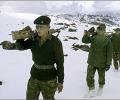
Virtually defending the latest incursion by the People's Liberation Army in the Chumar sector in Ladakh, China on Thursday said its troops were patrolling on its side of the Line of Actual Control and asserted that "status quo" should not be changed pending a final settlement.
China wants a code of conduct for troops on the India-China border areas. While the Indian side has reacted cautiously, it is not clear what effective additional protocols that the current proposed code will bring forth to usher stability in the border areas, says Srikanth Kondapalli.
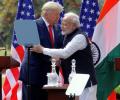
'New Delhi and Washington are now on the same page, on dealing with growing Chinese assertiveness, across the entire Indo-Pacific region,' notes Ambassador G Parthasarathy, Chancellor, Central University of Jammu.

Prime Minister Manmohan Singh has said that India and China should pursue an early settlement of the boundary issue as a strategic objective while not allowing such differences to affect the positive development of the bilateral ties. Describing his visit as "part of the recent happy tradition of high-level exchanges" between the two countries, Singh said "India-China relations have today transcended their bilateral dimension and have acquired global significance.

We should reassess what India's role in the world is and whether we are doing the right thing for ourselves, notes Aakar Patel.

China said it was committed to peace and tranquility at the border areas.
In a statement, the Prime Minister's Office (PMO) said the focus of Modi's remarks at the meeting on Friday was the events of June 15 at Galwan that led to the loss of lives of 20 Indian military personnel.

Giving an account of India's overall military modernisation, Lt Gen Pande also said that an in-principle approval has been given to new combat formations called the Integrated Battle Groups (IBGs) which can mobilise fast with a more effective approach.

India has told China that disengagement at all friction points is necessary to contemplate de-escalation of troops in eastern Ladakh even as the foreign ministers of the two countries agreed to establish a hotline for "timely" communication and exchange of views.

'One must remember that a dragon has a forked tongue,' warns Vivek Gumaste.
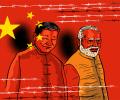
The reasons for China's negative response are located in its territorial dispute with India but also to its grand designs of dominating the region from its previous position of being merely a "balancer" between India and Pakistan, points out Srikanth Kondapalli, Professor in Chinese Studies at JNU.

Chinese President Xi Jinping is all set for an unprecedented third five-year term as he was 'elected' to the powerful Central Committee of the ruling Communist Party on Saturday while several top leaders including Premier Li Keqiang have been left out in the major shake-up at the top.
India and China failed to reach any specific agreements on their disputed boundary issue on Friday in the latest round of negotiations in Beijing but decided to pursue their goal for a "fair and reasonable" solution acceptable to both sides.

During the meeting on the sidelines of the 11th BRICS Summit on Wednesday, prime minister Modi said there was a "new direction and new energy" in bilateral ties after the two leaders' second informal summit in Chennai.

China has taken a position of non-acceptance and non-participation on the jurisdiction by the International Court of Arbitration in a case the Philippines has brought against China's claims to nearly all of the South China Sea, Abraham Denmark, Deputy Assistant Secretary of Defence for East Asia, told lawmakers at a Congressional hearing.

The prime minister and the Chinese president walked along the banks of East Lake and also took a boat ride together as they decided to step up their personal rapport.

From early indications, the Modi government's foreign policy seems to be pragmatic and reciprocal, says K G Suresh.
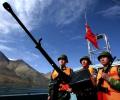
Both the Indian and Chinese armies have brought in more troops in sensitive locations like Demchok, Daulat Beg Oldie and areas around Galwan river as well as Pangong Tso lake in Ladakh, the sources said. The area around Galwan has been a point of friction between the two sides for over six decades.
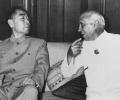
'The war of 1962 exposed the hollow intellectual foundations of Nehruvian foreign policy, especially vis-a-vis China and that is why it was such a shock.'

Closed meetings are not open to the public and no verbatim record of statements is kept.
'It was China's rise that caused the New Cold War in Asia as it prompted the United States to rebalance its forces in Asia to experiment with engagement and containment at the same time,' says T P Sreenivasan.

Downplaying the recent war of words with China, India on Wednesday expressed confidence that the boundary dispute would be resolved amicably through dialogue.

'I want to assure this House that in these talks we have not conceded anything.' Full text of what Defence Minister Rajnath Singh told Parliament on the Chinese pullback in eastern Ladakh.

Ahead of Chinese Premier Wen Jiabao's New Delhi visit, India and China on Monday explored ways to resolve the vexed boundary issue as the special representatives of the two countries held the 14th round of border talks in Beijng.

Chinese Foreign Minister Wang Yi arrived in India Thursday evening in the highest-level visit between the two countries after the ties came under severe strain following the eastern Ladakh standoff nearly two years ago.
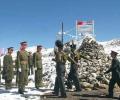
People familiar with the situation in the region said the two sides were engaged in trying to resolve the dispute, but there was no indication of a positive outcome yet as both the armies continued to bolster their positions in disputed areas of Pangong Tso and Galwan Valley and Demchok.
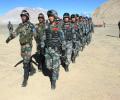
Indian and Chinese troops remained engaged in an eyeball-to-eyeball situation in several disputed areas.

Nevertheless, border dispute will feature prominently on Modi's agenda but the matter won't be discussed at length. Nayanima Basu reports
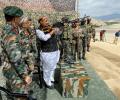
Having already received and deployed the first lot of around 72,500 Sig Sauer assault rifles from the US for counter-terrorist operations, the new batch of these assault rifles would be given to the soldiers deployed on the front with China in Eastern Ladakh.

Modi was expected to arrive in Wuhan in the evening on April 26 and join Xi in the informal summit at a picturesque location the next day.
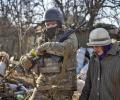
India has repeatedly called on Russia and Ukraine to return to the path of diplomacy and dialogue and end their ongoing conflict.

'The mood in Beijing is already nervous and feverously watchful.' 'Developments in China will be scrutinised as intensely and nervously as the ones in Washington,' says Claude Smadja.
On the eve of his visit to China, External Affairs Minister Pranab Mukherjee on Tuesday made it clear that Arunachal Pradesh is not disputed and that India will not give up its right over it.Talking to reporters in Chennai, he acknowledged that Chinese troops have been indulging in incursions and that Indian security forces had been asked to be alert and maintain vigil along the border to stop such intrusions."We have a democratically-elected government there," he said.

'India stands to gain immensely by forging a developmental partnership with China.' 'While through sustained strategic communication there is scope to steadily expand the commonality of interests between the two countries.' 'This is also a practical way to ensure that differences do not get over-magnified and become disputes,' says Ambassador M K Bhadrakumar.
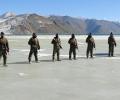
'The Arunachal border is not demarcated in that way, so there can be differing perceptions (between two sides)'
China said the soldiers of the People's Liberation Army were conducting 'normal patrols' on the Chinese side of the LAC.

Amid souring ties, the president visited Beijing for three days. On his return to India, a hope of better ties has arisen, says senior correspondent R Rajagopalan, who travelled with Pranab Mukherjee to the Asian superpower.

Prime Minister Narendra Modi and Chinese President Xi Jinping on Thursday began summit-level talks.
